In this guide
Why did these 21 bends become legendary?
The climb starts in Bourg-d’Oisans and reaches the resort through a spectacular series of hairpins. The signs are numbered in descending order. Originally used as markers for snow clearing, they now pay tribute to the stage winners at Alpe d’Huez.
La Garde-en-Oisans is home to the first ten bends, from number 21 to number 12. Bend 7, known as Dutch Corner, has become one of the most famous places in the Tour de France.
The climb profile
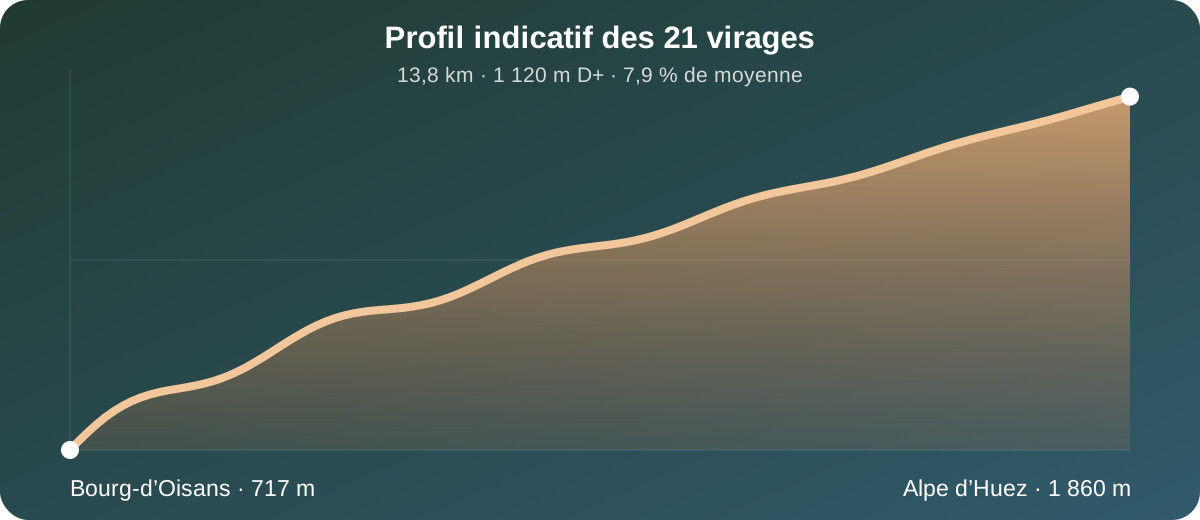 General profile, for guidance only. Use an official GPS track for a kilometre-by-kilometre breakdown.
| Figure | Commonly quoted official value | Key takeaway |
|---|---|---|
| Start | Bourg-d’Oisans, approx. 717–720 m | A short drag precedes the ramp |
| Finish | Alpe d’Huez, approx. 1,850–1,860 m | The exact finish varies by route |
| Distance | 13.8 to 14.454 km | Depending on where it’s measured |
| Elevation gain | Approx. 1,120 m | A long, sustained effort |
| Average gradient | 7.9 to 8.1% | The first few kilometres are steeper |
| Maximum gradient | 14% quoted | Low gearing is essential |
The 21 bends, from 21 to 1
The cards below describe the role each hairpin plays in managing your effort. The names on the signs change as new winners are added, so check them on the spot or with the resort.
La Garde-en-Oisans
The shock of the start
The first hairpin comes straight after the opening ramp from Bourg-d’Oisans. The gradient bites immediately: shift into your easiest gear before you actually need it.
La Garde-en-Oisans
Find your breathing
Your body isn’t fully warmed up yet. Don’t chase riders who have set off too fast – settle into a steady cadence.
La Garde-en-Oisans
Stay seated
The road keeps climbing steeply. Hold an efficient position and use the bend to pick up again without sprinting.
La Garde-en-Oisans
Your first real landmark
The valley starts to open up behind you. A great view doesn’t mean the hard part is over.
La Garde-en-Oisans
Approaching the village
Drink early, before the heat and altitude start to take their toll.
La Garde-en-Oisans
Entering La Garde
The village of La Garde-en-Oisans is home to ten of the twenty-one bends, from 21 to 12.
La Garde-en-Oisans
The rhythm settles
The gradients stay steep but the effort becomes easier to read. Keep to a pace you can sustain.
La Garde-en-Oisans
Don’t push too early
A few changes in gradient tempt you to speed up. Use them instead to relax your shoulders and have a drink.
La Garde-en-Oisans
Halfway is in sight
The countdown helps mentally, but there’s still a long way to go. Eat a little if you’ll be riding for more than an hour.
Leaving La Garde
La Garde’s last hairpin
You’re leaving the section that holds the first ten bends. The wind can become more noticeable here.
Mid-climb
A false sense of ease
The gradient can feel more even here. Even so, keep something in reserve for the upper section.
Mid-climb
The symbolic halfway point
Check your breathing, your legs and your hydration before tackling the last eleven hairpins.
Upper section
Into the upper section
The resort feels closer, but the remaining kilometres still count.
Upper section
The atmosphere builds
During big events, the crowds get much thicker. On normal days, stay alert to traffic.
Dutch Corner
Dutch Corner
Bend 7 is the famous Dutch Corner. During the Tour the atmosphere is extraordinary – but very crowded.
Upper section
Come down from the high
After bend 7, get back into your rhythm. Don’t let the atmosphere push you into a long surge.
Upper section
Fatigue gets technical
Your arms, back and concentration start to suffer. Shift your position slightly.
Approaching the resort
Preparing for the finish
The resort is close – but avoid launching your final effort too soon.
Resort entrance
The buildings appear
Watch out for vehicles, junctions and changes in road surface.
Resort entrance
Keep a final reserve
The gradient and the short kicks can still hurt. Breathe and avoid any sudden change of pace.
Alpe d’Huez
The last sign
The countdown is over – but depending on where the timing point or your chosen finish is, there’s still a stretch through the resort.
Gearing, pacing and climbing times
Which gearing?
For many leisure cyclists, a compact chainset combined with a cassette going up to 30, 32 or 34 teeth gives a useful margin. The right ratio lets you spin rather than grind through the first few kilometres.
What time should you aim for?
| Rider profile | Typical time | Goal |
|---|---|---|
| Very well-trained cyclist | Under an hour | Effort close to threshold |
| Regular cyclist | 1 h to 1 h 30 | Steady cadence |
| Well-prepared leisure cyclist | 1 h 30 to 2 h 15 | Finish without going into the red |
| First big mountain climb | 2 h or more | Breaks allowed, careful pacing |
The best spots for spectators
- Bends 21 to 18: where the riders face the most brutal gradients.
- La Garde: a village atmosphere and easier access.
- Bend 7: a huge party atmosphere, but extremely crowded.
- The upper bends: sweeping views down over the road and the valley.
- Resort entrance: riders up close and at higher speed.
During the Tour, respect the safety zones and road closure times. For the double summit finish in July 2026, the classic 21-hairpin climb hosted stage 19, won by Tadej Pogačar. See our Tour de France spectator guide.
How to prepare for the climb
Six to eight weeks before
- Gradually increase the length of your rides.
- Add one weekly session with long climbing efforts.
- Work on your cadence using the gearing you plan to use in the mountains.
- Test your food and drinks while riding.
- Check your bike position and comfort.
The week before
Cut back the volume, keep a few short accelerations and get plenty of sleep. A big last-minute ride won’t add any fitness.
The day before
Check your tyres, brakes, drivetrain and electronic shifting batteries. Get your bottles ready, plus an inner tube or tubeless kit, a pump and an extra layer for the descent.
Food and hydration
Have an easily digestible breakfast that you’re used to. During the climb, drink regularly and take on small amounts of carbohydrate if you’ll be riding for more than an hour. In hot weather you may need two bottles.
Don’t try a new energy drink on the day of the climb. Stomach problems are common when heat, intensity and unfamiliar products are combined.
The descent: the main risk
The road is wide but open to traffic outside events. Brake before the hairpins, stay in your lane and don’t cut corners. Take a break if your hands, your brakes or your concentration start to tire.
- Check tyres and brake pads before setting off.
- Take a windproof jacket.
- Avoid dragging your brakes continuously.
- Watch out for motorbikes, cars and other cyclists.
- Never overtake without clear visibility.
Extend your ride to Lac Besson or the Col de Sarenne
Riders with energy to spare can carry on from the resort to Lac Besson or create a longer loop over the Col de Sarenne. These variants add climbing, altitude and a wilder feel. Plan them from the outset, with enough water and time.